
Lowndes Projected vs Actual
A projected release date is a planned or computed date. It is not the same as the day the person actually walks out. For Alabama state prisoners, the public-facing term to watch is ADOC's "Minimum Release Date." ADOC defines it as the earliest scheduled date an inmate can be released to probation or end of sentence. The same definition warns that the date can change because of disciplinaries, good-time loss, new cases, or sentence changes sent by the circuit clerk.
For the John Hulett Detention Facility / Lowndes County Jail, the word "projected" may not appear in a public tool at all. A person held before trial may be released if bond is posted, a judge changes bond, a charge is dismissed, a warrant is recalled, or another hold is resolved. Those events are not sentence-computation dates. They are court or custody events. A person serving a local jail sentence may have a calculable end date, but local jail credit, holds, court orders, and any applicable good-time handling must be checked with the jail, sheriff, or court.
Scheduled dates help plan a verification path. Actual release still must be confirmed through the jail, ADOC, ABPP, VINELink, or the court record.
Find Lowndes Projected Release
The first step is to classify the person. If the person is still in the Lowndes County jail awaiting court action, the better question is whether a release order, bond, dismissal, transfer, or hold exists. If the person was sentenced to ADOC, the Alabama Department of Corrections inmate search may show current custody and release-related fields while the person is incarcerated. ADOC says its public search is current-only and does not provide online historical data.
Use the local court case when jail credit or sentence terms are unclear. ADOC defines jail credit as county-jail time before sentencing, prepared by the sentencing county circuit clerk. For Lowndes County cases, that makes the Lowndes County Circuit Clerk and the court record important sources for the sentence foundation. A wrong or changed sentence order can affect the date ADOC computes.
- Confirm whether the person is in Lowndes County jail, ADOC custody, federal custody, or another agency's custody.
- For a county jail detainee, call the jail or sheriff and check the Lowndes court case for bond, holds, and orders.
- For a state prisoner, search ADOC by AIS number when available; it is the fastest ADOC identifier.
- Read the ADOC fields as written: Minimum Release Date, Jail Credit, Good Time Received, Good Time Revoked, Parole Consideration Date, and Parole Status.
- Use ABPP if the question is parole, mandatory release supervision, home-plan verification, or a release after the Board grants parole.
- Set a VINELink notice for custody-change alerts when the person appears in the system.
ADOC Lowndes Date Fields
ADOC is not the Lowndes County jail roster. It becomes relevant when a Lowndes County defendant is sentenced to state prison or is already in state custody. The search fields also have limits. ADOC says an AIS number is a unique six-digit number and takes precedence over name fields. Name searches can be open-ended and can return up to 50 records, so broad name-only searches can miss the correct person.
The ADOC definitions page is the source for the release-date vocabulary shown below.
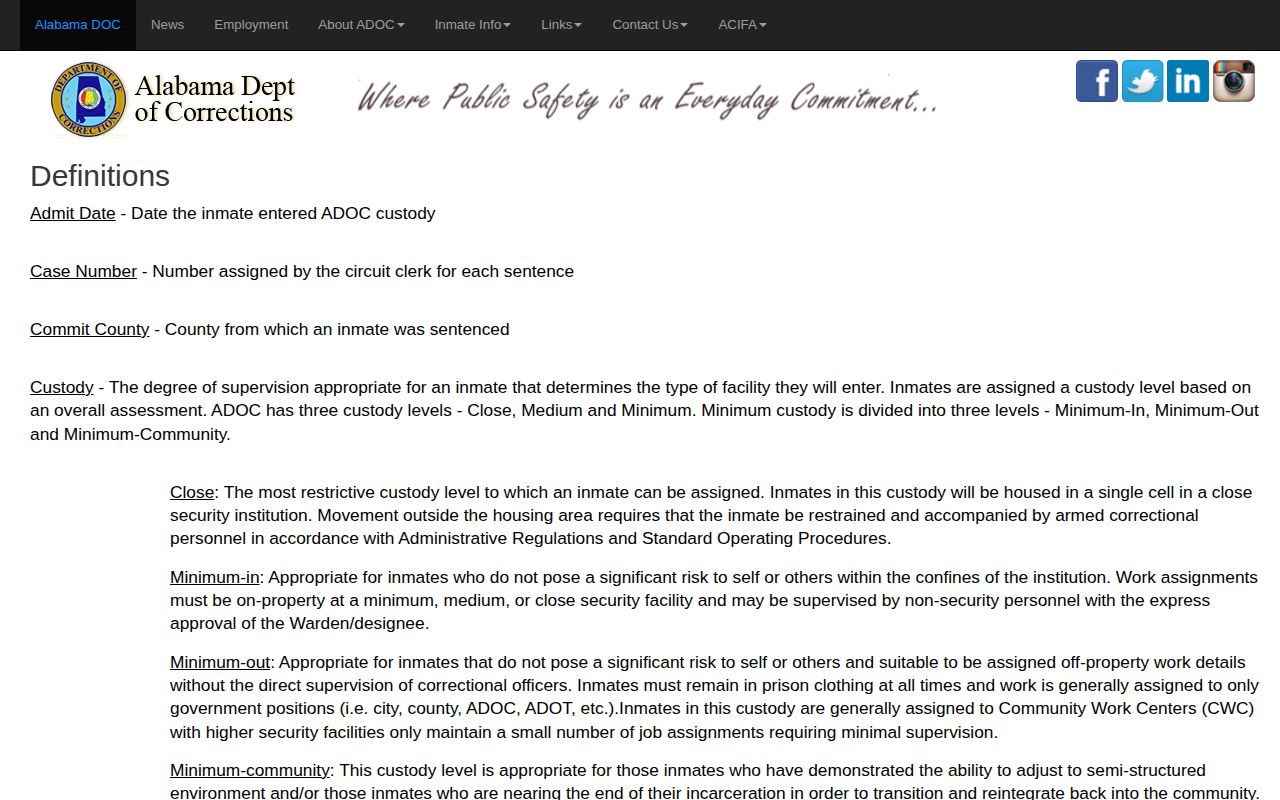
Those definitions are the reason a Lowndes County projected release search should use ADOC's exact field names instead of treating every date as a release date.
| ADOC field | How it affects release |
|---|---|
| Minimum Release Date | Earliest scheduled date for release to probation or end of sentence, subject to later change. |
| Jail Credit | County jail time before sentencing, prepared by the sentencing county circuit clerk. |
| Good Time Received | Correctional incentive time awarded to an eligible person. |
| Good Time Revoked | Previously earned time removed because of discipline or other qualifying conduct. |
| Parole Consideration Date | Tentative date set by the Parole Board for consideration, not guaranteed release. |
| Parole Status | May show whether the person is on parole, delinquent, or revoked while the record is public. |
Alabama Good-Time Rules
Alabama Code Section 14-9-41 governs correctional incentive time, often called good time. Under the statutory text captured in the Lowndes research, eligible Class I prisoners may earn 30 days for each 30 days actually served. Class II prisoners may earn 15 days for each 30 days served. Class III prisoners may earn 5 days for each 30 days served. Class IV prisoners earn none. These categories are not labels a records page should guess. They come from the correctional authority and the law.
The statute also excludes several categories from correctional incentive time, including Class A felonies, crimes causing death by deadly weapon, life sentences, death sentences, sentences over 15 years, and child sex offenses. It also allows forfeiture after rule or offense violations. That is why a Lowndes County projected release date can move backward after discipline or forward when eligible time is credited.
The Alabama correctional incentive time statute is the source for these categories and exclusions.
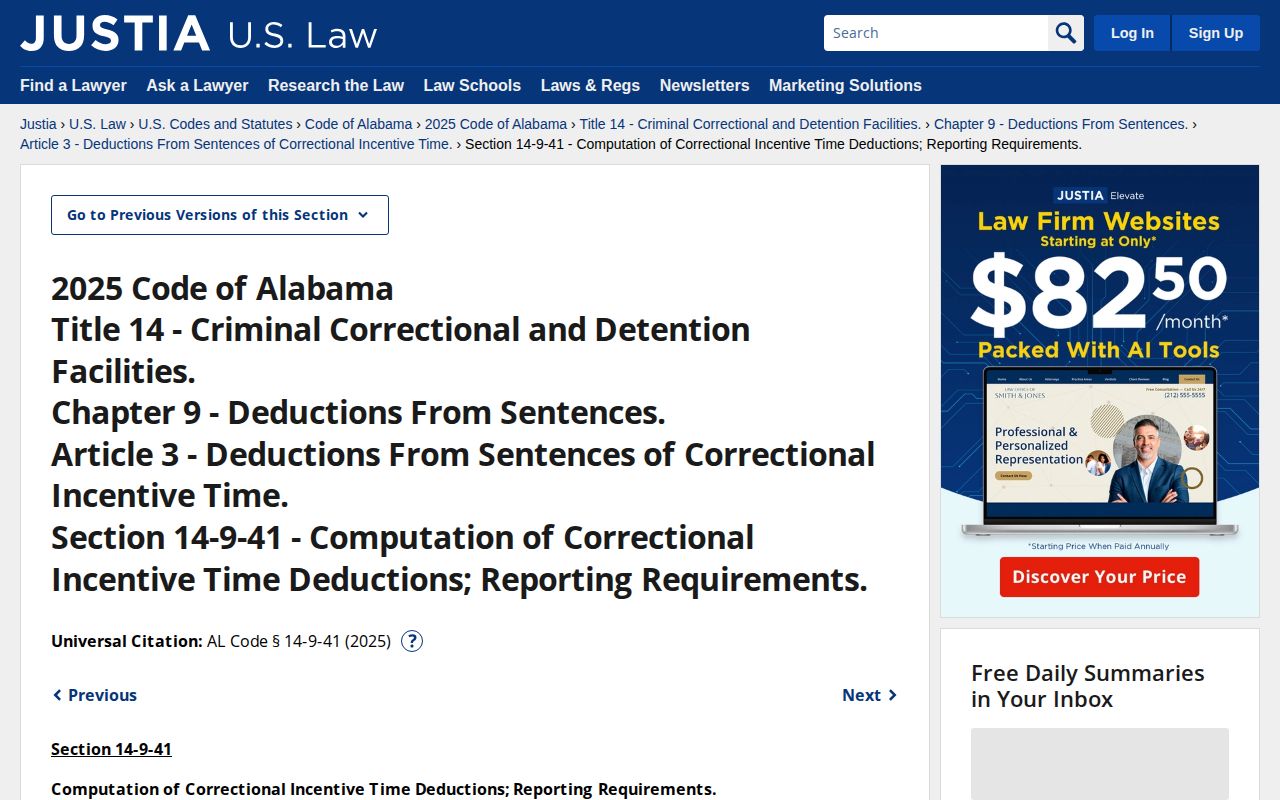
The statute also says ADOC administers the section for state penal institutions, while the sheriff administers it as it applies to county jail prisoners.
Lowndes Date Computation Traps
Alabama has two common date traps. First, ADOC's release field is "Minimum Release Date," which is a computed earliest scheduled date. Second, the "Parole Consideration Date" is a separate parole-board timing field. Treating the parole consideration date as the expected release date can create a bad read of the record.
Alabama Code Section 15-22-28 sets parole-consideration schedules. For specified Class A felonies committed on or after March 21, 2001, initial parole consideration is after completion of 85 percent of the total sentence or 15 years, whichever is less. For all other prisoners, the initial date is after one-third of the sentence or 10 years, whichever is less. For prisoners receiving correctional incentive time, the schedule is tied to sentence length and minimum release date.
This 85-percent rule is a parole-consideration rule for listed Class A felonies. It is not a universal rule for every Alabama release. A Lowndes County projected release date should be read with the offense, sentence, jail credit, good-time eligibility, and ADOC or ABPP field labels in view.
Why Lowndes Release Dates Change
A computed date is only as stable as the inputs behind it. ADOC states that new cases or sentence changes from the circuit clerk can change the minimum release date. Discipline can remove good time. ABPP may grant, deny, or reset parole consideration. A detainer can shift where a person goes even if one agency's custody ends.
| Change factor | Likely source to check | Effect on date |
|---|---|---|
| Good-time loss | ADOC or jail records | May push the minimum or local release date later. |
| New case or sentence change | Lowndes Circuit Clerk and ADOC | May alter sentence length, jail credit, or custody status. |
| Detainer or hold | Jail, sheriff, court, or receiving agency | May cause transfer instead of release to the community. |
| Parole grant or denial | ABPP hearing results and field office | May start home-plan review or leave the person in custody. |
| Mandatory release | ADOC and ABPP | May create supervised release before end of sentence for eligible people. |
Lowndes Mandatory Release
Mandatory release is separate from discretionary parole. ABPP's FAQ says Alabama Code Section 15-22-26.2 applies to offenses committed on or after January 30, 2016, with exclusions for child sex offenses and life sentences. The FAQ gives release-to-supervision ranges before the end-of-sentence date: three to five months for terms of five years or less, six to nine months for more than five but less than 10 years, and 12 to 24 months for 10 years or more.
ADOC determines the mandatory release date and coordinates with ABPP. That makes mandatory release a two-agency question. ADOC computes the custody side. ABPP handles supervision. For a Lowndes County case, the sentencing court and jail credit still matter because the sentence foundation can affect the state calculation.
Lowndes Jail Release Timing
A Lowndes County jail release date is more local than an ADOC minimum release date. If the person is awaiting trial, there may be no computed release date at all. Release may depend on bond, a judge's order, dismissal, sentence credit, a transfer, a medical event, a detainer, or another agency's hold. If the person is serving a county sentence, ask the jail or sheriff whether the person has a local sentence end date and whether any court order or hold affects it.
Alabama's correctional incentive time statute says the sheriff administers the good-time section as it applies to county jail prisoners. The Lowndes research did not find an official public Lowndes jail good-time, weekend-release, or holiday-release policy. Because of that, the page should not claim a local formula. The reliable path is to ask the jail for the custody status and release type, then check the court file for the sentence, jail credit, bond order, probation order, or disposition that supports the answer.
Lowndes Court Date Check
The Lowndes County Circuit Clerk page says court records are electronically imaged and that most trial-court information may be obtained through Alacourt or Just One Look with required fees. That court path matters because the circuit clerk prepares jail credit for sentencing, and court orders can change bond, sentence length, probation, dismissal, or warrant status. A projected release date can be wrong if the sentence foundation is wrong.
Use the court record to answer legal-cause questions, not live custody questions. A docket can show the order that should cause release or transfer. The jail, sheriff, ADOC, or ABPP confirms whether the custody system has acted on it. When those sources disagree, ask whether the court order has reached the custody agency, whether a detainer remains, and whether a transfer rather than release is pending.
Confirm Lowndes Release Date
Confirmation should use the agency that controls the current custody. For a county jail detainee, call the Lowndes County Jail or sheriff and check the court docket. The court directory lists the Lowndes County Jail at (334) 548-2222, and the sheriff page lists the sheriff office phone as (334) 548-6151. Because those numbers come from different official pages, treat them as source-labeled contact paths.
For a state prisoner, search ADOC while the person is currently incarcerated and use ADOC public records if the public search no longer carries the person. For parole or mandatory release supervision, check ABPP. For custody-change alerts, use VINELink Inmate Search when the person appears in Alabama VINELink. For federal custody, use BOP, not ADOC. For immigration custody, check ICE ODLS separately.
Note: If ADOC no longer lists the person, that may mean release, discharge, transfer status, a non-public category, or no current ADOC custody.